

I am not a wine person. I have never ordered it for myself. But whenever I am around people who are drinking wine, I taste it, to expand my taste horizons and see if there is anything I enjoy.
So far I have not found it.
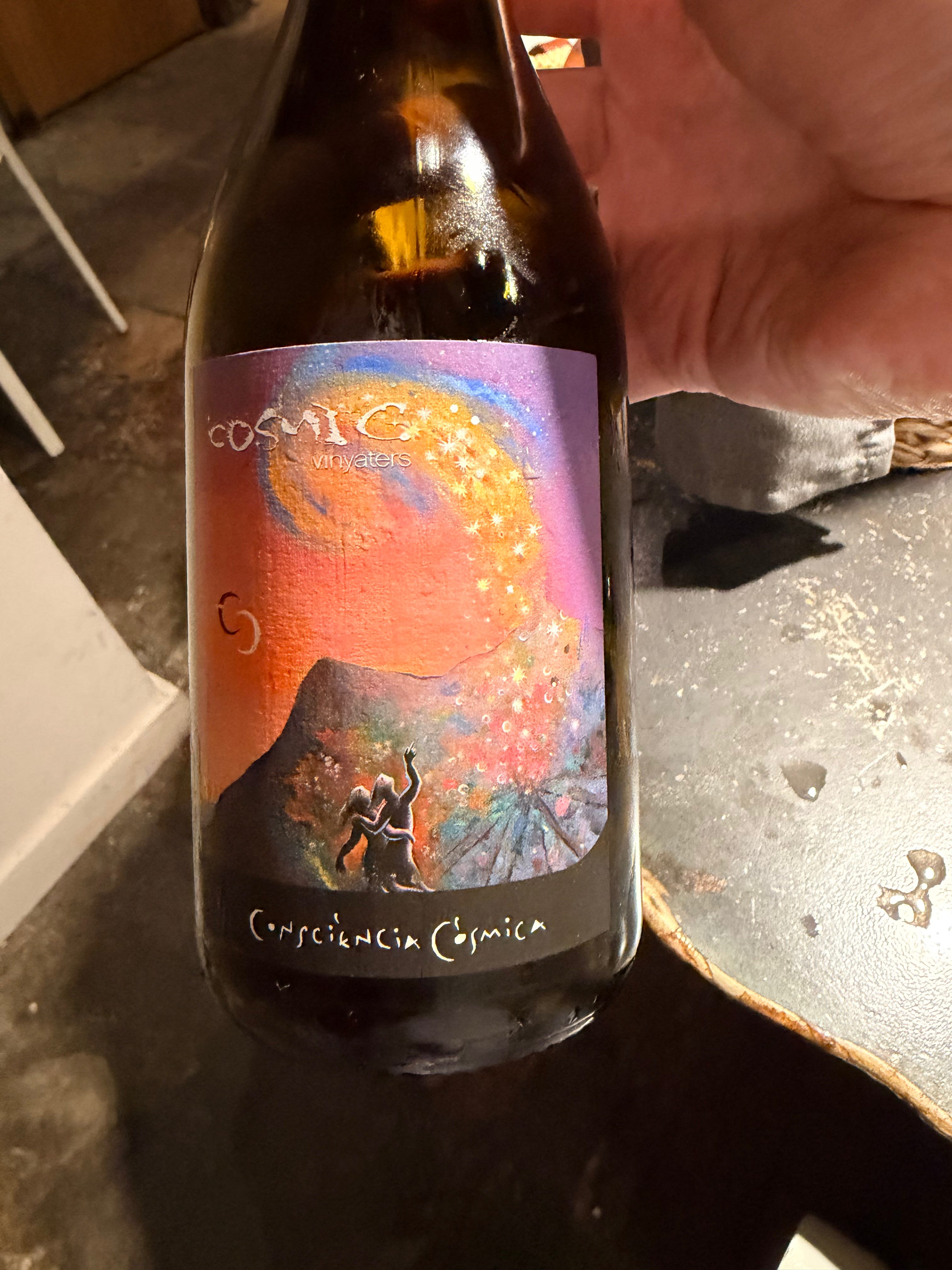
Last week in Barcelona I tried a weird bottle of wine, and I was pleasantly surprised. It tasted of kombucha with alcohol in it. Which, surprisingly, I prefer over normal wine.
The bottle is called Consciència Còsmica. It has 11%, which is quite low for a red wine.
In the early 1990s the average red wine was 12.7%. That figure comes from 91,432 bottles tested by the liquor board in Ontario, a province in Canada where the government controls every wine import and measures the real alcohol percentage in each bottle.
Between 1992 and 2007 the alcohol in those bottles rose by 1.12 percentage points, in every country in the study.
Today most red wines on the shelf are between 13 and 15%.
A lot of people say the reason is the weather. Warmer weather makes grapes sweeter, and sugar is what turns into alcohol. But the economists who had the Ontario data measured how much difference it actually makes. For every degree Celsius the growing season warms, the wine comes out 0.09 percentage points stronger, and the rise to explain is 1.12.
The bigger reason, the researchers think, is simpler. As a grape hangs on the vine the sugar in it climbs and the acidity falls, and the sugar it has on the day you pick it is what decides the alcohol. Farmers started leaving the fruit out longer, because riper fruit makes the bigger, bolder wines that critics and buyers were rewarding. Nobody was trying to make stronger wine. They were trying to make better wine, and the alcohol came up with it.
Which brings me back to the bottle.
Còsmic Vinyaters is one man, Salvador Batlle Barrabeig, in a village called Agullana, in the north east of Spain, about 15 minutes from the French border. He made his first wine at 16. He farms 9.5 hectares now, and his highest vineyard is the highest in all of Empordà, the region he works in. This bottle comes from up there.
The rest is a list of things he does not do. No synthetic chemicals in the vineyard. No bought yeast, only what was already living on the grapes. Fermentation in clay amphorae and steel, nothing added, and sulfites under 10 mg/l, which is close to none.
So why is this one 11%?
I do not know for certain, and I could not find him saying. But here is what I believe.
Part of it is the altitude. Grapes up high sit in cooler air and take longer to ripen, so there is less sugar in them when they are picked.
Part of it is that nothing is added. If you do not put sugar in, you do not get the alcohol that sugar would have made.
But most of it is what he is aiming at. The farmers who left their fruit out longer were chasing ripeness. Batlle says he is after freshness, acidity and tension, and those fall away as the sugar climbs. You cannot have both.
He is not making a low alcohol wine. He is making a fresh one, and the 11% comes with it.
The whole industry has been moving in one direction for decades. This one went the other way, from the top of a mountain, and came out like almost no other wine.
If you do not like the taste of normal wine, but you do like kombucha, and you have nothing against alcohol, you should try this one. It is about as pure a fermentation as you can buy, and it was genuinely interesting to drink.
It did not taste like a wine with something taken out of it. It tasted like a wine that nobody had pushed.